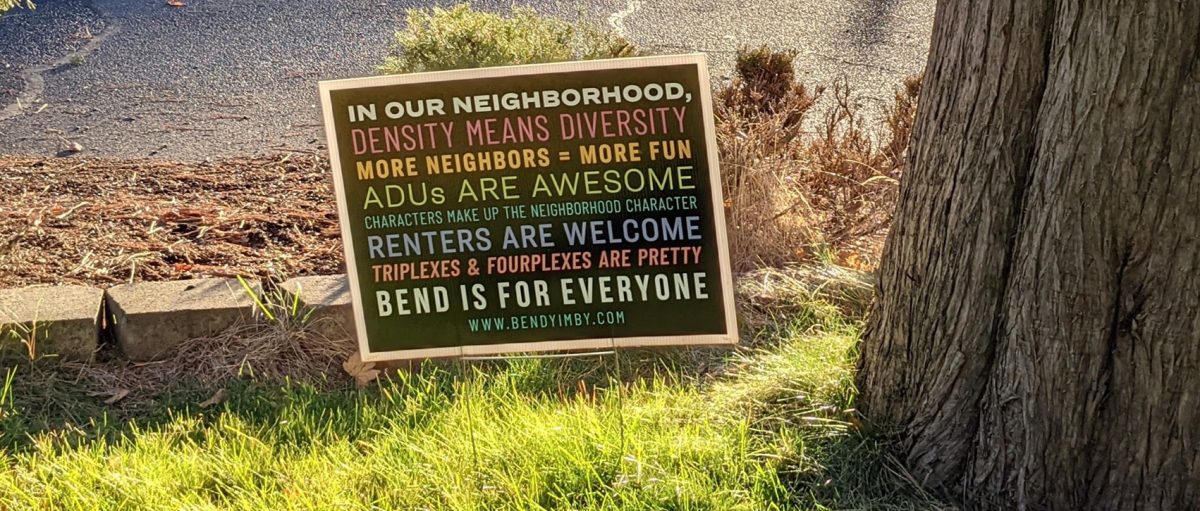
Bend YIMBY was started eight years ago to advocate for housing of all types, shapes and sizes. Like many popular cities throughout the country, Bend has a housing shortage. Many estimates put that number to be more than 6,000 housing units (aka homes). We believe that in order for Bend to be a thriving, growing city everyone who works here or wants to live here should have a place to live. Here. In this wonderful city. Not having enough homes available for everyone, particularly homes that people can afford causes all sorts of economic, social, safety and fairness issues. It manifests itself in homelessness or long, environmentally horrible commutes. It shows when employers struggle to hire service workers or highly trained specialists coming out of school. And it’s apparent when renters are competing with dozens of others for a simple apartment.
The past two years have seen some progress. 2024 should be a record year for completed apartments and as we predicted that is beginning to temper rent increases. Multiple pieces of legislation have eased some of the regulatory burden for building smaller homes and there is likely to be more of this in the coming years. We’ve been successful in advocating for special taxing districts that have kept multi unit projects going. And we’ve seen some significant changes at the state level that may further our efforts. We always wish we could get more done and were sad to see some projects not get built for various reasons. But these past eight years have seen significant growth in our agenda, our following and our political gravitas. Plus we have a City Council that by and large “gets it”.
As we have in previous election cycles, we sent all local candidates questionnaires asking them a couple of questions related to housing ( https://docs.google.com/spreadsheets/d/1wOSa5fYCRh3F1PiHMwwvgJDRq2raIzcZ7ITzwx7R36U/edit?usp=sharing ). Further we co-sponsored a recent city council candidate forum focused on housing—you can watch that here https://www.youtube.com/watch?v=xvPVSXHysfM . After studying the questionnaire responses and listening to their answers during the forum, Bend YIMBY members voted on each position. Although several council candidates did not return our questionnaire, they did participate in the forum so we did not automatically exclude them from consideration and instead based our choices on their stage performances.
Here then are our endorsements for this year’s local elections.
State Senate: Anthony Broadman
When Broadman decided to run for what eventually became an open Oregon State Senate seat, we were sad to see him go, as he has been a solid YIMBY ally on Council. He has a deep understanding of the technical issues facing legislative change and has been willing to face thorny local political issues head on. As housing becomes a huge part of the Governor’s legislative agenda we are confident that Broadman will be an advocate for YIMBY housing issues in the State Senate.
City Council Position #1: Megan Norris
Norris is a two year incumbent having been appointed to Council in 2022. She works in the housing production industry, which gives her some good insights, but has been quick to do the right thing and recuse herself on matters that involve her employer. She has great working knowledge of the challenges faced by both the City and the industry in changing our system to encourage the building of needed housing. She has been a critical supporter of some of the recent, politically hot button, tax votes and based on her performance at the candidate debate has a good grasp of some of the specific issues council is considering for the coming two years.
City Council Position #2: Gina Franzosa
This was Anthony Broadman’s seat and Franzosa is running unopposed. We still endorse her candidacy as she too has shown solid understanding of the technical issues facing the city in its quest to build more housing. We love the idea of re-legalizing “complete neighborhoods”. Franzosa has experience in small scale housing development as well as engineering and we feel she will be a worthy replacement to Broadman on the Council.
City Council Position #3: Megan Perkins
Perkins was elected to council in 2020 and soon thereafter volunteered to be the point person for Council’s work on homelessness. It is a very difficult problem with no easy, short term answers, and thus a challenging job, and risky politically. And yet she has persevered. Like the Mayor and Broadman she has a great understanding of the wonky details behind tax and code issues and has proven to be a tireless voice for those without stable housing. She deserves to be re-elected to another term.
City Council Position #4: Steve Platt
Of the four Council positions up for a vote this was the most difficult choice because there are two candidates that understand the challenges facing our community and the levers available to City Council to deal with them. The incumbent, Barb Campbell, has generally been supportive of our advocacy and she brings a certain institutional knowledge to the dias having served on council for a decade. We are grateful for her dedicated service. However, Platt brings a broad understanding of the issues, and a critical thinking approach to finding solutions that reflects his experience as a high school teacher and Air Force fighter pilot veteran. He also has budget management experience both at the federal level and serving here on the City’s budget committee—a vital asset worth having on Council. His answers to our questionnaire, his willingness to meet with our group and learn what we advocate for, as well as his forum performance showed he has not only the energy to dive into the issues but also the foundation to make well informed policy decisions.


 Bend YIMBY